

Identification
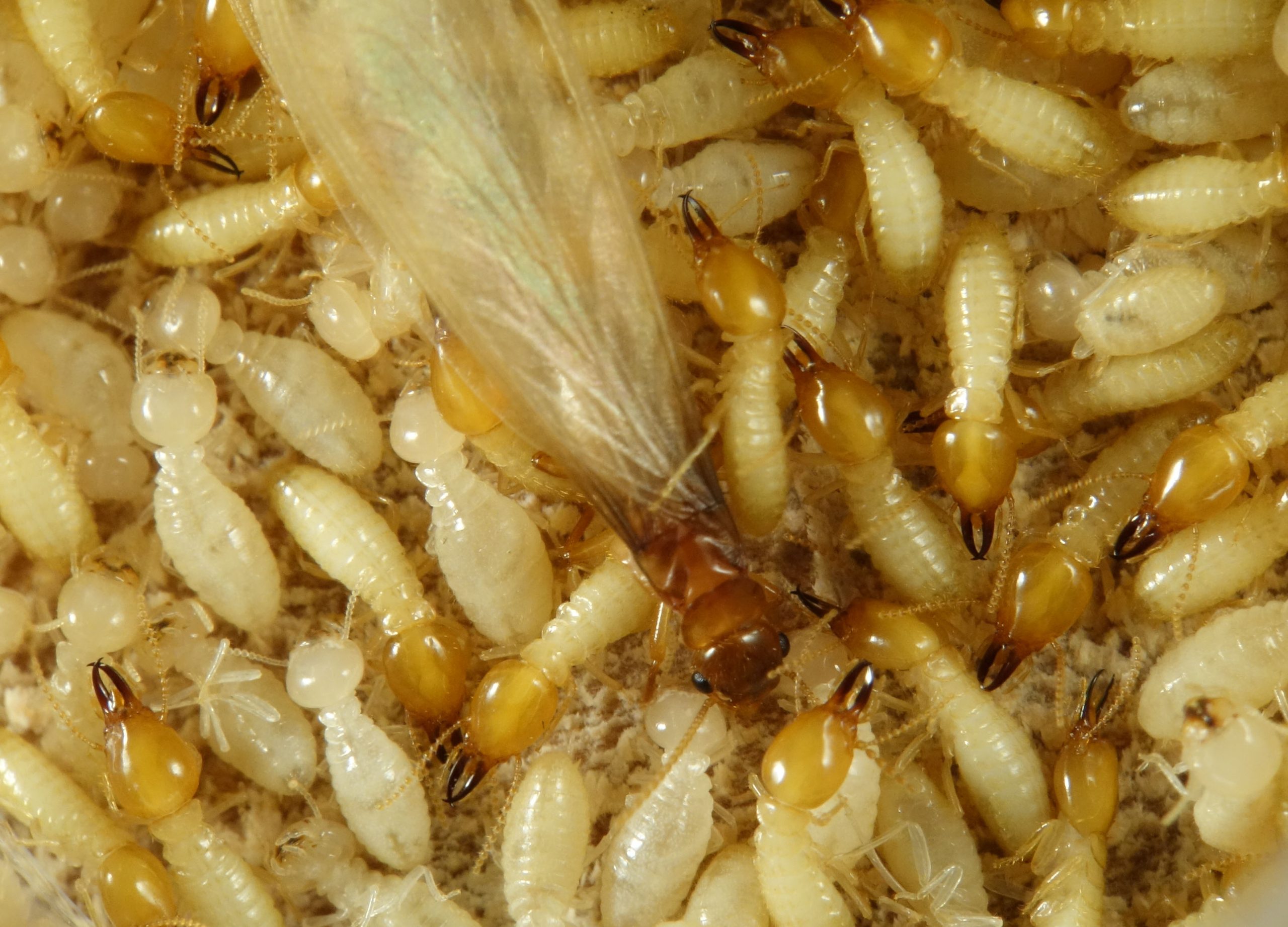
Formosan termites are considered social insects. Three forms, called castes, are found in the colony – reproductives (winged or wingless), soldiers and workers (pseudergates). Soldiers and winged reproductives (alates) are the castes used for identification purposes.
Workers: Workers of Formosan termites are white to off-white in color and are difficult to distinguish from other termite species. Therefore, soldiers or reproductive caste termites are needed for proper identification. Although ants often swarm at the same time of year as do termites, it is easy to distinguish ants from termites by the shape of their bodies, wings and antennae. They are also referred to as psuedergates
Soldiers: Formosan termite soldiers have tear dropped or egg-shaped, heads compared to the more rectangular head of native subterranean termites. Formosan termite soldiers are more aggressive than native subterranean termite soldiers. When disturbed, they will exude a small amount of a white defensive secretion from a gland called the fontanel, located on the front of the head. They can also attach themselves to a finger with their mandibles (mouthparts). Soldiers will make up between 5-10 percent of a colony.
Winged reproductives (swarmers): Winged Formosan termite reproductives or “swarmers” are yellowish-brown and 12-15 mm (0.5-0.6 inch) in length. They swarm at night in late May and early June and are attracted to lights. They have a dense covering of hair on their transparent wings. There are some drywood termites that also have a honey-brown color and are about the same size as Formosan termites. Like the Formosan termites they swarm at night and are attracted to artificial lights. The two species can, however, be distinguished by identifying features such as veins in the wings and characteristics of the head. If identification is in doubt, the termites should be submitted for identification to Center for Urban and Structural Entomology, 2143 TAMU, College Station, TX 77843-2143, (979) 845-5855.